
Paying Taxes / Penalties in UAE in 2026: Rules, Risks, and Best Practices
Paying taxes in the United Arab Emirates (UAE) is technically a straightforward process. However, from a legal and compliance perspective, it can be sensitive. Errors in payment details, incorrect payment sources, or mismatches in banking information may lead to delays, payment blocks, or additional compliance checks.
Below is a structured overview of how to pay taxes and penalties in the UAE in 2026, including the main payment methods and the key risks associated with international transfers.
Who Receives Tax Payments in the UAE
All tax obligations in the UAE are administered by the Federal Tax Authority (FTA).
The Federal Tax Authority (FTA) accepts tax payments through several methods:
- bank transfer (wire transfer)
- e-Dirham payment system
- payments through local UAE banks
- in certain cases – international SWIFT transfers
Each payment must be properly identified in order to be automatically allocated to the correct tax liability.
Mandatory Payment Details for UAE Tax Payments
Regardless of the payment method used, the following information must be correctly indicated:
- TRN (Tax Registration Number)
- tax liability or penalty reference number (if applicable)
- clear payment description
- payment currency – UAE Dirham (AED)
If any of these details are incorrect, the payment may not be automatically matched by the Federal Tax Authority system.
This may result in manual verification and payment delays.
Methods of Paying Taxes in the UAE
1. Payment from a UAE Corporate Bank Account (Recommended Option)
This is the safest and most common method of paying taxes in the UAE.
Advantages
- minimal compliance risks
- faster payment processing
- no additional banking inquiries
Important condition
The bank account must belong to the same company that holds the Tax Registration Number (TRN). The company name in the bank account must fully match the company registered with the Federal Tax Authority.
2. Payment from a Corporate Account in Another Country
UAE legislation does not prohibit paying taxes from a foreign bank account, but this method carries certain risks. The main risk: banking compliance checks.
If a company registered in the UAE pays taxes:
- from a bank account in another jurisdiction
- or from an account belonging to another legal entity
the bank may:
- request proof of the relationship between the payer and the UAE company
- ask for group structure documentation or contracts
- temporarily freeze the payment for review
Important requirements
- the account should belong to the same legal entity
- company names and registration details must match
- the payment must be made in UAE Dirhams (AED)
3. Risk of Tax Requalification (International Tax Perspective)
In certain situations, tax payments made from outside the UAE may raise international tax structuring concerns.
If a company:
- is effectively managed from another country
- holds bank accounts only outside the UAE
- pays taxes exclusively from another jurisdiction
this may create a risk that the company will be considered a tax resident of another country under the Place of Effective Management (POEM) principle.
This becomes particularly relevant in the context of:
- double taxation treaties
- international tax structuring
- automatic exchange of financial information (AEOI)
The issue becomes more sensitive if:
- the company claims economic substance in the UAE
- the company undergoes annual audit
- financial data is shared between jurisdictions under international reporting standards
Can One Company Pay Taxes or Penalties for Another Company in the UAE?
UAE legislation does not prohibit one company from paying the tax or penalty of another company, even if the companies are unrelated.
The Federal Tax Authority (FTA) primarily evaluates whether the tax liability has been paid.
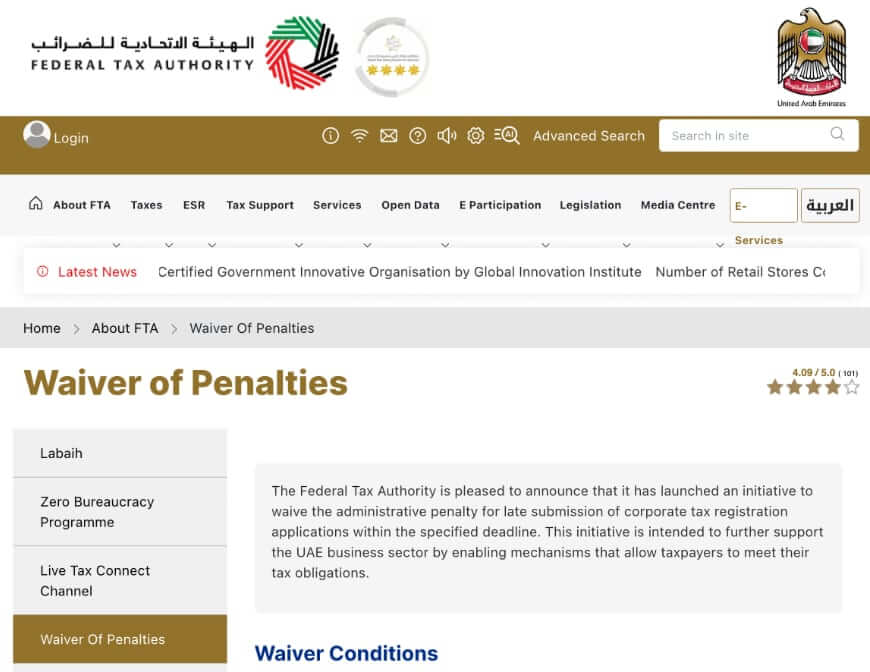
However, several practical considerations must be taken into account.
1. Payment Identification
The payment must clearly indicate:
- the TRN of the debtor company
- the tax liability or penalty reference number
If the payment cannot be properly identified, the Federal Tax Authority may:
- fail to allocate it automatically
- credit it as an overpayment to the wrong entity
2. Documentation Between Companies
It is strongly recommended to formalize the transaction with proper documentation, such as:
- a cost reimbursement agreement
- a loan agreement
This is important for:
- accounting purposes
- regulatory audits
- substantiating the economic rationale of the transaction
3. Accounting and Tax Treatment
A company paying taxes on behalf of another legal entity:
- cannot treat such payment as its own tax expense
Instead, it should be recorded as:
- receivable
- loan
- advance payment
Incorrect accounting treatment may create risks during audits or financial reviews.
When It Is Not Advisable to Pay UAE Taxes from Abroad
It is generally better to avoid foreign tax payments if:
- the company claims substantial economic presence in the UAE
- the company undergoes financial audit
- the corporate structure is sensitive to tax residency analysis
- the jurisdictions involved participate in automatic exchange of financial information
In such cases, paying taxes from a UAE corporate bank account significantly reduces regulatory and compliance risks.
Can taxes in the UAE be paid from a European bank account?
Yes, technically it is possible. However, it may trigger bank compliance checks and additional documentation requests.
Must taxes be paid in UAE Dirhams (AED)?
Yes. Payments to the Federal Tax Authority (FTA) must be made in UAE Dirhams (AED).
Can a third party pay a company’s tax penalty?
Yes. UAE law does not prohibit third-party payments. However, the payment must clearly include:
- the company’s Tax Registration Number (TRN)
- the tax liability or penalty reference number
It is also advisable to document the transaction with a contract or loan agreement.
What happens if the TRN is entered incorrectly?
The payment may not be automatically allocated, and reconciliation with the Federal Tax Authority may be required.
Can paying taxes from another country affect tax residency?
In certain situations, yes. If the company is effectively managed from another jurisdiction, it may create a risk of being treated as a tax resident in that country.
Is a contract required if one company pays taxes for another?
It is highly recommended. Proper documentation helps reduce accounting and tax risks and confirms the economic substance of the transaction.
